
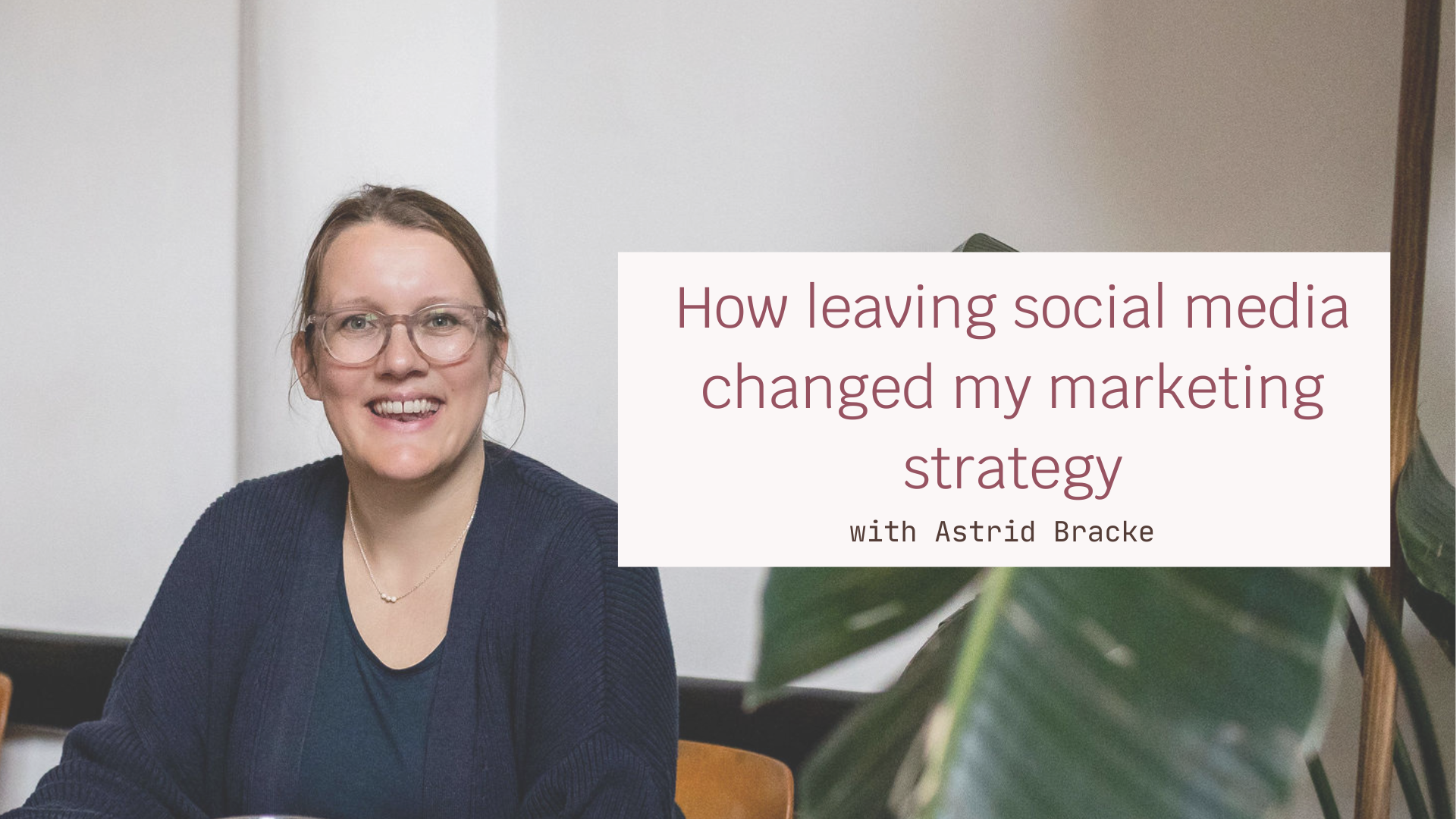
If you’ve ever wondered whether you actually need social media to market your small business—this video is my answer.
A few years ago I left Instagram. Not strategically, not with a plan, and not with a big audience waiting for me anywhere else. When I eventually came back to marketing my business, I knew I didn’t want to return to social media. This left me having to figure out how to market my business without social media, which used to be a big part of it. A few years on, the system I ended up with is better for me, better for my business, and, somewhat to my surprise, more effective than what I had before.
My solution was to formulate three rules for myself by which I decided where, how and how often I market my business.
How (and why) I left
In October 2021 I launched a new product (my Boundaries for small business owners guide), and I’d spent more time on Instagram in the run-up than usual. When the launch was over I took a two-week break. That break quietly turned into forever—first because I became ill and spent a couple of months unable to touch my business at all, and then, once I was well enough to pick things back up, because staying off simply felt good. It still does.
So when I returned to marketing, I wanted to be intentional about it. I set myself three rules. Having these rules gives me incredible calm and focus in my marketing.
–> Read this deep dive into How I quit social media for my business
Rule one: I don’t want to serve a platform
I was tired of the game, of trying to work out what the algorithm wanted this week, then next week. With Instagram I’d tried all of it: the hashtags, the posting times, posting five times a week, posting less. And the feeling that kept growing was that I was working for Instagram rather than for my business.
Of course, every platform involves some exchange. I run my website on WordPress, so by paying them I support them too. But that’s a clean, clear trade to me. What I felt on Instagram was something murkier, and I didn’t want to keep paying it.
Rule two: people should be able to find me—and go beyond the platform
I wanted it to be easy to discover my business, and just as easy to click through to something that mattered: my website, my newsletter, my products. Social platforms are built to keep people on the platform. I wanted the opposite. I wanted people to go beyond it. That tension between what Instagram wanted and what I wanted was a constant irritation that turned into frustration and annoyance.
–> Read more on the 4 benefits of marketing my business without social media
Rule three: the platform has to fit my strengths and needs
This is the big one. Before I explain it, a quick note on what I mean by “social media”, because a few of the channels I use now might look like social media. I see YouTube and Pinterest as search engines, not social platforms: I am not rewarded for my attention, which for me is a key part of how platforms like Instagram work.
When I thought about marketing that fits my strengths and needs, three things came up.
The first is that I do my best work in longer form. Snappy, quick, clever little posts are really hard for me to make. Long-form is what I love to read and what I love to create. So I started with my newsletter—the thing I most enjoy writing—and looked at how to make it work harder: more sign-up forms on my site and in my email signature, a few Pinterest pins pointing to it, and going from sending it twice a month rather than once a month.
That same desire for longer content is what eventually drew me to YouTube, despite years of being sure video wasn’t for me. When I pictured video as reels and shorts, all of it loud and fast, video indeed didn’t fit. The slightly slower, longer format YouTube (also) allows is a different thing entirely, and one that I’m enjoying playing with.
The second thing that is important to me is that I want my marketing to be evergreen. The average social post lasts a day or two, if that. For content I found hard to make, watching it vanish felt like a small heartbreak every time. So I looked instead at what was evergreen instead: my blog, SEO, Pinterest. Before writing this I checked my top pins: the best three are three to four years old and still quietly bringing people in. My blog does the same. I did the work once, and now it ticks along in the background, getting richer rather than disappearing.
The third thing I focused on is the ability to schedule. What bothered me most about social media was the exchange of attention for reach: the more time you spend on the platform, the more it tends to show your work. That just doesn’t work for me. I get overwhelmed easily, I’m neurodivergent, I’ve had stretches of poor mental health, and spending a lot of time on social media isn’t good for me. So I schedule almost everything: the newsletter, the YouTube videos, my blog posts, my pins. I can write or record whenever the energy and the creativity are actually there, and let it go out later. This isn’t a productivity hack. It’s how I look after myself.
–> Curious about moving your business away from social media? Sign up for my popular free 4-week email series “Move your business away from social media” 💌
Something to try
The question I’d leave you with is the one I answered myself: which rules are you setting for how you market your business? What is important to you?
I’d love to hear your thoughts–leave a comment here.
If this resonated, come join the waitlist for Grow, my marketing programme. You’ll get gentle, non-overwhelming tips for building a marketing system that’s intentional, sustainable, and actually yours — and you’ll be first to hear when it opens again.
Join the newsletter for more like this
Sign up with your email address to receive strategies, experiments and tips to create a slow, gentle and profitable business–no hustle, no hacks.